
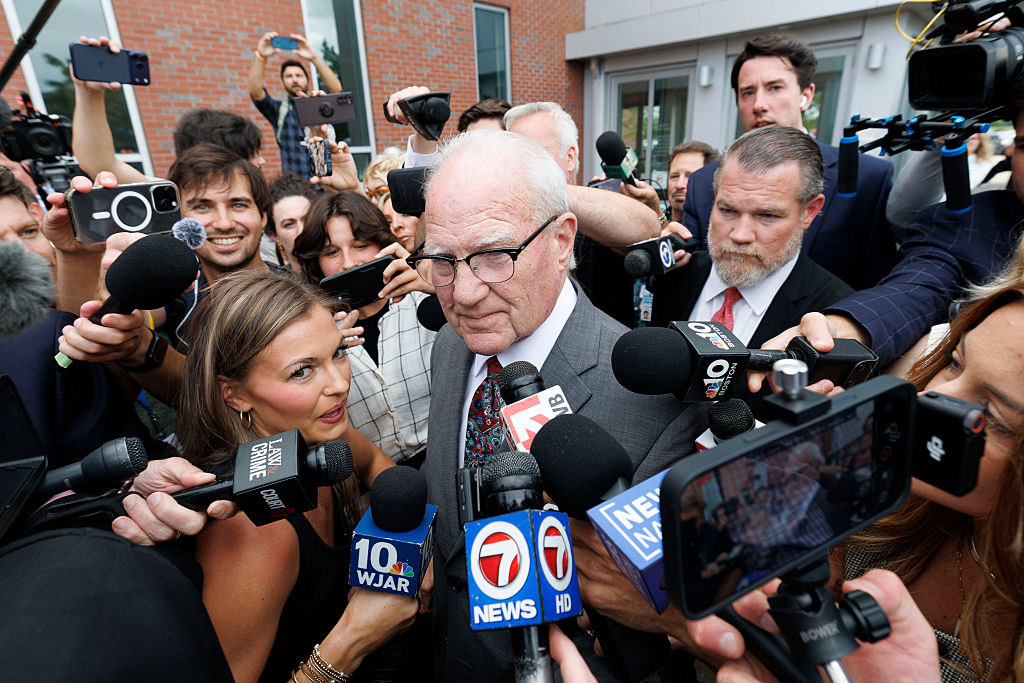
Defense attorney Kevin Reddington is surrounded by the press as he leaves the courthouse earlier this month following the conclusion of deliberations for the sixth day in the trial of Lindsay Clancy in Plymouth, Massachusetts. Clancy pleaded not guilty to murdering her three young children, with her attorneys arguing she was suffering from postpartum psychosis and did not receive adequate mental health care despite seeking treatment and support. (Photo by CJ Gunther/Getty Images)
If you are having thoughts of suicide, call or text 988 to reach the 988 Suicide and Crisis Lifeline or go to SpeakingOfSuicide.com/resources for a list of additional resources.
The mistrial in Lindsay Clancy’s murder trial earlier this month places her future in doubt, three years after she killed her three children in Duxbury, Massachusetts.
But one potential outcome is a state legislative push to boost mental health support for new mothers.
“Becoming a mother is a profound life change, and every parent deserves support — not just during pregnancy, but in the months that follow,” Democratic Massachusetts Gov. Maura Healey said in a statement announcing new proposed funding to expand mental health care services for mothers of newborns.
“Postpartum depression, anxiety and other maternal mental health conditions are real medical conditions, and no mother should feel ashamed to ask for help or feel like she has to navigate this journey alone.”
Postpartum depression is common, affecting up to 1 in 7 women after they have a baby, according to the Cleveland Clinic. Common symptoms involve anxiety, mood swings and feeling overwhelmed.
More rare and potentially deadly is what Clancy’s lawyers argued that she was suffering from: postpartum psychosis, which is more severe and affects between roughly 1 and 3 women per 1,000 births. Possible symptoms include insomnia, delusions, hallucinations, mania and thoughts of self-harm or harming others, especially the newborn. Symptoms develop quickly and require immediate psychiatric help.
Healey is asking the Massachusetts legislature for $2 million to expand the state’s Welcome Family program, under which new mothers receive one free visit from a nurse with specialized maternal and child health training. The goal is to increase the number of households served each year from 3,000 to 68,000.
Several other states took action this year.
Pursuing a similar strategy to Massachusetts, Illinois enacted a law that aims to support at-home mental health screenings for all new mothers.
Other states focused on insurance coverage: Maryland enacted a law requiring the state’s Medicaid program and some other insurers to cover screenings for postpartum depression, while a new law in Virginia mandates that all insurance plans offered in the state cover maternal mental health screenings.
Other bills related to postpartum depression or psychosis were considered but failed to pass in Georgia, Mississippi, Nebraska, New Jersey, New York, Oklahoma and West Virginia.
Joy Burkhard, CEO of the Policy Center for Maternal Mental Health, whose mission is to close gaps in maternal mental health care, said the Clancy case is likely to fuel even more state legislation addressing postpartum mental illness.
She said states might look to Illinois, which in 2018 enacted a law recognizing postpartum illnesses like depression and psychosis to be mitigating factors in criminal sentencing. Last year the state began requiring these disorders to also be mitigating factors around parole and medical-release decisions for women who are incarcerated.
“We’re expecting quite a big influx of interest by legislators, and perhaps being approached by their constituents to take action post the trial,” Burkhard said. “Last year we had a 50% increase (in legislation). … I would expect that could grow as high as a 200% increase from last year.”
State action can make a difference, according to a recent study in the journal Frontiers in Public Health. Researchers found that among 32 states that have tried to address postpartum depression, the ones with the most robust policies and funding had lower maternal mortality rates.
Not all types of state legislation are equally robust.
Several states this year have introduced maternal mental-health awareness resolutions, which Burkhard said are a good first step. But what could really move the needle, she said, are laws that require insurance reimbursement of mental health services and being able to access postpartum mental health care through one coordinated practice, such as their OB-GYN or midwifery practice.
Burkhard said the Illinois and Massachusetts home-visit laws are good starts but are less effective than allowing mothers with newborns to access all their maternal health care in one place.
In California, awaiting the governor’s signature is proposed legislation Burkhard thinks possibly could have made a difference in a case like Clancy’s.
Clancy pleaded not guilty to murder, her attorneys arguing she was suffering from postpartum psychosis — she heard disturbing voices in her head — and did not receive adequate mental health care despite seeking treatment and support. Lawyers also argued Clancy’s doctors were not communicating with one another. Clancy attempted suicide soon after the killings and is now paralyzed from the waist down.
California’s bill would require health insurers to provide case management or care coordination for enrollees who screen positive for a maternal mental health condition.
“The care coordination could have actually supported Lindsay Clancy,” Burkhard said. “Because she saw so many providers, and you know just sort of that through line and that continuity and having some support to say this is what we’ve already done, just really could have maybe, possibly led to different outcomes for her.”
Researchers have found that suicides account for about 20% of postpartum deaths, and that early treatment for postpartum psychosis increases the chances for good outcomes.
But many women face significant barriers to getting care, including a widespread lack of understanding and awareness about postpartum mental health illness.
According to a national maternal health survey conducted by the Harris Poll in March, about 36% of women who have been pregnant said they were diagnosed with a mental health condition during or leading up to their pregnancies, and 56% reported having postpartum mental health struggles. Of those, more than half said they received no or subpar mental health support.
According to the survey, 65% of women wanted health providers to proactively ask about their postpartum mental health and needs during prenatal visits, but nearly half, 46%, said they did not receive enough resources.
After a weeklong trial, the jury could not reach a unanimous verdict of whether to hold Clancy criminally responsible for the death of her children. All but one of the 12 jurors were ready to find Clancy not guilty by reason of insanity, and the judge declared a mistrial. She is expected to continue to be held in a state psychiatric hospital while waiting for a potential retrial, WBUR reported.
This story has been updated to remove Delaware as one of the states where a postpartum depression/psychosis bill failed this year. Stateline reporter Sofia Resnick can be reached at sresnick@stateline.org.
This story was originally produced by Stateline, which is part of States Newsroom, a nonprofit news network which includes Georgia Recorder, and is supported by grants and a coalition of donors as a 501c(3) public charity.